

Monday, October 14, 2013

A Billboard That Condenses Water From Humidity
Interesting precedent as we get closer to Part II of our semester!

Monday, October 7, 2013

Thursday, October 3, 2013

Tuesday, October 1, 2013

Monday, September 30, 2013

Sunday, September 29, 2013


Tuesday, September 24, 2013
Intellectual Farming p2
Intellectual farming
is using collective knowledge to cultivate a product in which we understand the
affects our farming has on the ecosystem. A collective approach drives a
further understanding of how a production loop affects the environment and how
much of a closed loop it is, much like the teachings of the book, Cradle to
Cradle. For me this understanding of what we use and throw away that will bring
sustainable ideas to life and help to create cycles in which our activity no
longer is a detriment to the world and all its fragile ecosystems. To ensure
our survival, each of the systems we affect should be in equilibrium and
without the sharing of collective knowledge, we will ensure the destruction of
our world's ecosystems.
Sunday, September 15, 2013
Lessons Learned from Hurricanes?

Checking the weather before some NFL games, I found this The Weather Channel spot that I thought would be relevant Part2 design polemic fodder. 2 minutes spot.
With his entire life in shambles after Hurricane Charlie, Andy Boyle decided to rebuild - smarter, safer and "green-er." He shut down his coastal condos for 16 months, set up an outdoor office and invested 12 million dollars to rebuild his paradise.
Check out the 175 mph impact balcony doors. Man vs Nature indeed.
** OH YEA **
If anyone teams would like some feedback on their drafts for TOPIC 2, send us a PDF!
Saturday, September 14, 2013
SectionCut - a collection of design resources

Hello Class,
I have been working on a pretty sweet little project called SectionCut for the last few months, and I feel that it will be incredibly useful to you as BAC students. S|C is a kind of one-stop-shop to find great ANALOG and DIGITAL design resources available. It is S|C's mission to build a collection and a trusted design community, making us all better at what we do.
If you're considering purchasing architecture books or looking for tutorials, you might want to take a look at what trusted 'brains' have already recommended in a certain category. If you want to share your own favorite resources as a contributor, let me know. If not, you can still keep tabs, visit us, and like us on the S|C Facebook page. Let me know if you find this interesting/useful - I would value your feedback!
Cheers, Kyle
Monday, September 9, 2013
Intellectual Farming
Farming to me is using knowledge in order to produce a product. This product is the result of using a intellectual collective understanding used to cultivate an idea into reality. Since becoming interested in sustainable design, it is apparent how many lack an understanding of how human activity affects the Earth's habitat and by cultivating an increased knowledge of our impacts we can cultivate new and innovative solutions that reduce our impacts using knowledge collected from different sources. Farming our understanding of the world around us an creating a collective of specialists will in turn would create innovative sustainable design.
To me a collective analysis of the waste from our activity should completed so we can understand how something starts and ends. Much like in cradle to cradle, a complete production loop from the things we use should be designed such that our activity has no affect on the environment, or at least a positive one. From human waste, to trash, to water use, it is everything we use and throw away that will create sustainable ideas cultivated from our collective knowledge. To ensure our survival on the planet, each of the systems we affect should be in equilibrium, otherwise we will ensure our mutual destruction.
To me a collective analysis of the waste from our activity should completed so we can understand how something starts and ends. Much like in cradle to cradle, a complete production loop from the things we use should be designed such that our activity has no affect on the environment, or at least a positive one. From human waste, to trash, to water use, it is everything we use and throw away that will create sustainable ideas cultivated from our collective knowledge. To ensure our survival on the planet, each of the systems we affect should be in equilibrium, otherwise we will ensure our mutual destruction.
What Will I Farm.....
"Farming harnesses the efficiency of collectivity and community."
- White & Przybylski
I believe that our most valuable resource as human beings, is the ability to collaborate. The "mind crops" are full of diversity and rich with knowledge. Ideas can be strongest when different disciplines are able to come together and cross pollinate ideas. For example Biomimicry, what can the Architect learn from the Biologist? or the Chemist, and so on.
It is a dream of mine to one day provide the facilities (the field), the initiation (planting the seed), and the financial support (the fertilizer) for the genius of separate fields to collaborate and inspire one another and produce a beautiful crop of thoroughly thought out ideas. No one person can ever be omniscient and a design can only become stronger by introducing new schools of thought to it. A form of integrated design that ensures diversity of perspective. In short, I want to harvest brains.

- White & Przybylski
I believe that our most valuable resource as human beings, is the ability to collaborate. The "mind crops" are full of diversity and rich with knowledge. Ideas can be strongest when different disciplines are able to come together and cross pollinate ideas. For example Biomimicry, what can the Architect learn from the Biologist? or the Chemist, and so on.
It is a dream of mine to one day provide the facilities (the field), the initiation (planting the seed), and the financial support (the fertilizer) for the genius of separate fields to collaborate and inspire one another and produce a beautiful crop of thoroughly thought out ideas. No one person can ever be omniscient and a design can only become stronger by introducing new schools of thought to it. A form of integrated design that ensures diversity of perspective. In short, I want to harvest brains.
Sunday, September 8, 2013
Sylvia Williams
Week 2 – What will I farm?
I want to
positively impact the world using wind turbine farms to create the power for
electric railroad systems in America. We
live in fast paced and polluted world with limited access to local to regional
railroad systems. There are forgotten
and unused railroads throughout the States that should be reutilized to support
my vision. Flying and driving cross-country
are suitable options but damage our environment with pollution and oil will run
out eventually, then we will be in a transportation disaster. To prevent worse case transportation scenarios,
I want the United States to have a long-term transportation plan using wind
turbine farms. Wind turbines are minimal
harm to the environment and produces large amounts of energy that can channel
this transportation opportunity.
What will I 'Farm'?
After
reading about tissue-engineering meat in On
Farming -which for me is extreme- my farming ideas are more abstract than
tangible. I will farm:
1.
Over population social awareness (globally)
2.
Global and Temporary birth control-policies
3.
Regulations on urban inhabitation
It is a fact that one of our major issues is
the fast growing population around the World, which bring issues as scarce
resources such as food, water and energy, also bring high risks of epidemics of
mortal diseases. The population is
growing faster than the design and implementation of sustainability approaches
that could address our global crisis. I will concentrate efforts in
simultaneous strategies to control one of the main factors threatening the
future of our well being in this Planet. The development of possible solutions
for our global crisis has to be in a holistic fashion, we have to attack the
base of the problem, educate the people and then implement the strategies.
Farming…
When
I think in farming something, I would farm 2 things that might not help a lot
to the food crisis, but might help our ecosystem and definitively our stress
levels. As a child I grew up in a natural reserve seeing a bio-luminescent bay in front of my house in Puerto Rico, also seeing lots of fireflies. Unfortunately
both conditions are not longer as evident today as they were 20 years ago. The
reason for this is the pollution in the water (do to motor boats) and the
pollution of artificial light do to the rapidly urbanization of the area. So, I will create a farm in the bay for single-celled
bioluminescent dinoflagellates (Pyrodimium bahamense) and a reserve area to farm fireflies.
On Farming... Green Opportunism
"Farming harnesses the efficiency of collectivity and community. " - Maya Przybylski and Mason White (bracket-)
Taking into account the above quote from the introduction of bracket- , my impression is that we, as a group of collaborating students and faculty, will be farming green technologies this semester. Our collective research efforts is a type of information and technology farming that will hopefully precipitate improved sustainable building solutions. Solutions that will hybridize buildings and landscapes and resolve the centuries old tension between nature and technology.
Personally, I am convinced that for truly "sustainable" and effective solutions to local and global environmental, economical, and social issues there is a need for farming of hard and soft infrastructure along with technology and nature. In my opinion, simply creating buildings that act as "green machines" will not have significant enough impacts on lifestyles without being plugged into the physical and social infrastructures that are already in place, or that can be co-generated. The "Farm-to-Table" postal program in the early 1900s is a good example of such a hack (25 bracket-).
In short, I want to farm opportunities, much like the aquaponics system, of systems thinking.
Taking into account the above quote from the introduction of bracket- , my impression is that we, as a group of collaborating students and faculty, will be farming green technologies this semester. Our collective research efforts is a type of information and technology farming that will hopefully precipitate improved sustainable building solutions. Solutions that will hybridize buildings and landscapes and resolve the centuries old tension between nature and technology.
Personally, I am convinced that for truly "sustainable" and effective solutions to local and global environmental, economical, and social issues there is a need for farming of hard and soft infrastructure along with technology and nature. In my opinion, simply creating buildings that act as "green machines" will not have significant enough impacts on lifestyles without being plugged into the physical and social infrastructures that are already in place, or that can be co-generated. The "Farm-to-Table" postal program in the early 1900s is a good example of such a hack (25 bracket-).
In short, I want to farm opportunities, much like the aquaponics system, of systems thinking.
human relies on food, information and energy to survive. But if the earth goes out of its current ecological status no one will survive. So keeping the Earth healthy would be my first intention to consider for creating a farm. our planet is suffering from air and water pollution. Given that 2/3 of our planet is filled with water and its the source of life to nature, I would farm for clean water to preserve the current condition of atmosphere from getting worse. Consequently it would help for better air, agriculture, life quality production. This can be achieved by two ways: One cleaning the polluted water supplies. Two farming for clean water in lands in need of water.
Thursday, September 5, 2013
Original Work!
Hi 50SOG crew,
Thanks for a strong second class. I just want to re-iterate as it seemed unclear to a few of you, but all drawings created for next week need to be original work. The first week it is really helpful to collect and share some of the aspects of your case study research and the successful diagrams/data you've found - but we also absolutely expect to see drafts of your original drawings and page layout options at that time. This allows us the opportunity to have a really productive discussion about your own representations at a more detailed level.
This week, you should rely on the discussions we had on the first night and notes from your peers. We'll do our best to send emails with individual comments through the weekend - but the more you show us the more we can help. Squeaky wheel gets the grease!
Cheers, K+L
Thanks for a strong second class. I just want to re-iterate as it seemed unclear to a few of you, but all drawings created for next week need to be original work. The first week it is really helpful to collect and share some of the aspects of your case study research and the successful diagrams/data you've found - but we also absolutely expect to see drafts of your original drawings and page layout options at that time. This allows us the opportunity to have a really productive discussion about your own representations at a more detailed level.
This week, you should rely on the discussions we had on the first night and notes from your peers. We'll do our best to send emails with individual comments through the weekend - but the more you show us the more we can help. Squeaky wheel gets the grease!
Cheers, K+L
Geothermal Energy in Large and Small Scales
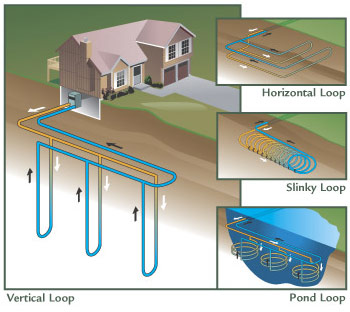
Since these
geothermal ‘hot spots’ are only in specific geographical locations throughout
the world, a more commonly available technology has been developed called
ground source heating.

Ground source heating can supply a home or building with
heat and air conditioning supply practically at any location.
The ground source heating uses the temperature differential of the above and below ground air temperature to draw hot or cold air out of buildings.
This air then gets channeled through underground piping to supply the comfortable living temperature for any home or building.

Subscribe to:
Posts (Atom)